


Posted under: DB, Employee Benefits, News
By Pat Johnston, FCIA, FSA – GBL | Published October 1, 2026

Starting April 1, 2027, pension commuted values in Canada will be calculated using a new mortality basis: the CPM2024 mortality table with the MI-2024 mortality improvement scale. It replaces the CPM2014 table and CPM-B improvement scale that have been used as the mortality basis for commuted values since 2015.
The new basis reflects lower mortality rates, so commuted values, along with life expectancies, will go up. Our sample calculations show increases of about 1.8% TO 5.4% using discount rates applicable to October 2026 calculations. Solvency liabilities will rise too. Here’s what’s changing, why, and how plan sponsors can prepare.
A commuted value is the lump-sum value at the time of calculation of a member’s future pension. Members who leave a defined benefit (DB) pension plan can often transfer this amount out of the plan instead of taking a pension later. The transfer typically goes to a locked-in retirement account.
On August 31, 2026, the Actuarial Standards Board (ASB) approved a new mortality basis for calculating commuted values. The ASB sets the standards of practice for actuaries in Canada. The new basis takes effect April 1, 2027:
Table 1. Mortality basis for pension commuted values
| Assumption | Current basis (to March 31, 2027) | New basis (April 1, 2027 onward) |
| Base mortality table | CPM2014 | CPM2024 |
| Mortality improvement scale | CPM-B | MI-2024 |
CPM2024 is the Canadian Institute of Actuaries’ (CIA) new pensioner mortality table, published in March 2026. It is based on recent mortality experience from Canadian registered pension plans, with observations through 2021 and extended observation for a subset of the data through 2023. The dataset is roughly three times the size of the one behind CPM2014. For commuted values, the ASB adopted the combined CPM2024 table, with amount-weighted rates and separate rates for males and females. Note that notwithstanding the approval for separate rates for males and females, most provincial jurisdictions require that commuted values be determined with blended male and female mortality rates.
MI-2024 is a new mortality improvement scale that reflects updated expectations for future gains in longevity. Some industry commentary refers to it as CanMI-2024.
Table 2. Timeline of the change
| Date | Milestone |
| March 11, 2026 | CIA publishes the CPM2024 pensioner mortality research |
| May 6, 2026 | ASB proposes the new commuted value mortality basis, with a February 1, 2027 effective date |
| August 31, 2026 | ASB approves the new basis, effective April 1, 2027 |
| April 1, 2027 | New basis takes effect for pension commuted values |
The new basis assumes pension plan members will live longer, so pensions are expected to be paid for more years. More years of expected payments means a higher value today, so commuted values generally increase.
Our analysis shows that most of the increase comes from the change in the mortality improvement scale (MI-2024). The change in the base mortality table (CPM2024) has a relatively modest effect.
The two pieces measure different things. A base mortality table sets today’s mortality rates at each age. An improvement scale projects how quickly those rates will fall in future years. MI-2024 assumes a long-term improvement rate of 1.3% a year for many adult ages, compared with 0.8% under CPM-B. Compounded over a member’s lifetime, that faster improvement in future mortality rates adds a significant period to projected life expectancy.
Under the new basis, life expectancy at age 50 in 2027 increases by about two years for both men and women, with varying effects at other ages.
The increase in probability of being alive at a future age relative to the current mortality basis is largest at advanced ages. The probability that a 50-year-old man lives to 100 rises from 5.1% to 13.0% (from about 1 in 20 to about 1 in 8). For a 50-year-old woman, it rises from 10.7% to 20.5% (from about 1 in 9 to about 1 in 5). These changes reflect significantly stronger expectations for future longevity improvements.
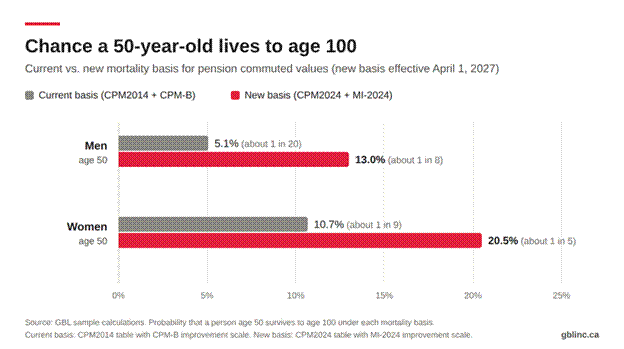
Figure 1. Chance a 50-year-old lives to age 100 under the current and new mortality bases. Source: GBL calculations.
Table 3. Male, age 50: life expectancy and survival probabilities
| Measure | Current basis (CPM2014 + CPM-B) | New basis (CPM2024 + MI-2024) | Change |
| Life expectancy | 36.92 years | 38.88 years | +1.96 years |
| Probability of living to age 70 | 91.30% | 92.93% | +1.63 pts |
| Probability of living to age 80 | 79.34% | 81.48% | +2.14 pts |
| Probability of living to age 90 | 46.88% | 53.78% | +6.90 pts |
| Probability of living to age 100 | 5.06% | 13.00% | +7.94 pts |
Table 4. Female, age 50: life expectancy and survival probabilities
| Measure | Current basis (CPM2014 + CPM-B) | New basis (CPM2024 + MI-2024) | Change |
| Life expectancy | 39.69 years | 41.69 years | +2.00 years |
| Probability of living to age 70 | 94.30% | 95.36% | +1.06 pts |
| Probability of living to age 80 | 85.08% | 87.36% | +2.28 pts |
| Probability of living to age 90 | 58.36% | 65.17% | +6.81 pts |
| Probability of living to age 100 | 10.67% | 20.50% | +9.83 pts |
“pts” = percentage points.
To illustrate the practical impact, we calculated sample commuted values as at April 1, 2027 under both bases. We used discount rates and inflation assumptions applicable to October 2026 calculations along with these assumptions about the member and pension entitlement:
Table 5. Sample commuted values for a 50-year-old member
| Pension form | Guarantee period | Post-retirement indexing | Commuted value: current basis | Commuted value: new basis | Increase ($) | Increase (%) |
| Lifetime | 5 years | None | 280,136 | 287,254 | 7,118 | 2.5% |
| Lifetime | 5 years | 100% CPI | 364,185 | 377,917 | 13,732 | 3.8% |
| Joint & 60% survivor | 5 years | None | 297,567 | 304,201 | 6,634 | 2.2% |
| Joint & 60% survivor | 5 years | 100% CPI | 394,818 | 408,797 | 13,979 | 3.5% |
In these scenarios, commuted values increase by about 2.2% to 3.8%. The largest increases are for pensions with full CPI indexing, because a longer expected payment period amplifies the value of future inflation-adjusted benefits.
The impact varies by age. Younger members generally see a smaller increase in dollars, because their commuted values are typically lower. As a percentage of the commuted value, however, their increase is generally slightly larger, because future mortality improvements apply over a longer period.
The impact also depends on the commuted value discount rates in effect. Lower discount rates make commuted values more sensitive to changes in mortality assumptions, because payments expected far in the future carry greater present value.
Table 6. Increase in commuted value by member age and discount rate (same four pension forms as Table 5)
| Member age | Discount rates | Increase in commuted value |
| 30 | October 2026 rates | 3.0% to 5.4% |
| 40 | October 2026 rates | 2.7% to 4.6% |
| 50 | October 2026 rates | 2.2% to 3.8% |
| 60 | October 2026 rates | 1.8% to 2.9% |
| 50 | 1.0% lower than October 2026 rates | 2.7% to 4.5% |
For any individual member, the impact will depend on several factors. These include age, benefit design, indexing provisions, retirement age assumptions and the discount rates in effect on the calculation date.
The new basis applies to pension plans that determine commuted values in accordance with subsection 3530 of the Standards of Practice for Pension Plans. Plan sponsors should expect higher commuted values for members who terminate employment or retire with a lump-sum settlement option on or after April 1, 2027.
The change will also increase pension solvency liabilities for actuarial valuations performed with an effective date on or after April 1, 2027. That’s because solvency valuations use the commuted value basis for members assumed to take a lump sum. This change will not affect the portion of the solvency liability that is based on estimated annuity purchase rates for retirees or deferred pensioners that are assumed to select an annuity if the plan were wound up.
Commuted values for multi-employer pension plans (MEPPs) and target benefit pension plans are often based on the mortality rates assumed for the plan’s going-concern funding. These plans are not obligated to apply the new mortality basis.
Plan sponsors should prepare for higher lump-sum settlement values and the related effect on pension plan costs and administration:
The ASB’s new mortality basis for commuted values, effective April 1, 2027, reflects updated expectations for future longevity improvements in Canada.
For most pension plans that determine commuted values under subsection 3530, commuted values will increase if there is no change to the other prescribed assumptions. In our examples, the increase is about 1.8% to 5.4%, with the precise impact varying by member characteristics and plan design. Plan sponsors should be ready for higher lump-sum settlement values and the corresponding effect on pension plan costs and administration.
Commuted values will be calculated using the CPM2024 mortality table with the MI-2024 mortality improvement scale, replacing the CPM2014 table and CPM-B improvement scale. The Actuarial Standards Board approved the change on August 31, 2026.
In GBL’s sample calculations, commuted values increased in a range of 1.8% to 5.4% using discount rates applicable to September 2026 calculations. The exact increase depends on the member’s age, pension form, indexing and the discount rates in effect.
The new basis assumes pension plan members will live longer, so pensions are expected to be paid for more years. Most of the increase comes from the MI-2024 improvement scale, which projects faster future improvements in longevity than CPM-B.
CPM2024 is the Canadian Institute of Actuaries’ new pensioner mortality table, based on recent Canadian registered pension plan experience. MI-2024 is a mortality improvement scale that projects how mortality rates will change over time. Together, they form the new commuted value mortality basis.
It applies to pension plans that determine commuted values under subsection 3530 of the Standards of Practice for Pension Plans. Multi-employer pension plans and target benefit plans often base commuted values on their going-concern funding assumptions and are not obligated to use the new basis.
Yes. It will increase pension solvency liabilities for actuarial valuations performed on or after April 1, 2027 for plans that apply subsection 3530 of the Standards of Practice for Pension Plans in determining pension commuted values. This change will not affect the portion of the solvency liability that is based on estimated annuity purchase rates for retirees or deferred pensioners that are assumed to select an annuity if the plan were wound up.
Life expectancy at age 50 in 2027 increases by about two years for both men and women. The probability that a 50-year-old man lives to 100 rises from 5.1% to 13.0%; for a 50-year-old woman, it rises from 10.7% to 20.5%. It will have different effect for individuals at different ages.
On its own, the new mortality basis will generally produce a higher commuted value. But commuted values also change monthly with changes in the applicable discount rates, and those movements can substantially outweigh the effect of the mortality assumption. Get advice on your own situation before timing a decision.
| Questions about the new mortality basis? We can show you how the change will affect your plan’s commuted values, solvency position and funding. Reach out to us for a consultation by visiting www.gblinc.ca or calling Ryan Ackers at 403.249.1820 x 238. |
Pat Johnston, FCIA, FSA, is Senior Vice President & Actuary with GBL and has over 40 years of actuarial and pension experience. In 2003, he founded Pension Strategies Inc., which joined GBL in 2023. Pat continues to provide services for corporate and public sector pension plans, IPPs, RCAs, family law pension-related services, and other expert evidence work.
GBL is a national actuarial consulting firm headquartered in Calgary, with an office in Toronto. Since 1995, GBL has served plan sponsors and administrators with pension and health benefits consulting, actuarial valuations and executive compensation strategies. GBL also maintains a monthly Pension Plan Interest Rates database (CANSIM, commuted value and marriage breakdown rates) for the Canadian actuarial and pension administration industry.
Related reading: PS 3251 Employee Benefits: Major Changes to Public Sector Accounting Standards, by Pat Johnston.
This article is for general information only and is not actuarial, legal or financial advice. Results for a specific plan or member will differ.
